
Introduction: Why Conversational AI Platforms in 2026 Are More Than Just Chatbots
Welcome to 2026. The landscape of digital interaction has fundamentally transformed.

are no longer a novelty or a simple customer service add-on; they are a core component of digital strategy, deeply integrated into customer experience, sales enablement, and internal operations. The paradigm has shifted dramatically. We've moved beyond the era of reactive, single-channel chatbots that merely answer questions. Today's leading solutions deliver proactive, behavior-triggered engagement, seamlessly blend multimodal interactions across text, voice, and vision, and are architected as orchestrated fleets of specialized,
agenticAI agents. This guide is designed for the CTOs, CXOs, and product leaders tasked with navigating this complex and powerful ecosystem to find the right
ai solution. We will provide a detailed, data-backed framework to help you evaluate the current vendor landscape and select the best
conversational AI platformto meet your organization's sophisticated 2026 needs and drive measurable business growth.
Key Concepts Defining the Best Conversational AI Platforms in 2026
To make an informed decision in 2026, it's essential to grasp the foundational concepts that separate legacy tools from modern, intelligent platforms. These trends are not just features; they represent fundamental architectural and strategic shifts that define the capabilities of the top conversational AI vendors today. Understanding them is the first step toward choosing the
right conversational aiand building a future-proof AI strategy.
Proactive Engagement: A Core Feature of Top Conversational AI Platforms
The most significant evolution in conversational AI has been the pivot from a reactive to a proactive stance. Old-school chatbots were passive, waiting for a user to type a specific query into a widget. Modern AI, however, acts as an intelligent digital partner. In 2026, advanced platforms use real-time data streams and user behavior analytics to initiate valuable, context-aware conversations. Imagine an AI noticing a high-value customer repeatedly viewing a complex product page. Instead of waiting, the AI proactively opens a dialogue: "I see you're looking at our enterprise plan. Would you like to see a comparison with your current setup or connect with a specialist?" This shift from passive query-handler to active engagement engine is a game-changer for conversion, support, and
conversational commerce.
Multimodal Communication: How Voice AI is Shaping Platforms in 2026
Siloed, text-only customer experiences are now obsolete. Users expect to interact with businesses as naturally as they do with people, using a combination of modalities. The
top conversational AIplatforms now treat text, voice, and vision as fluid, interchangeable inputs within a single, persistent conversation. A truly multimodal conversation, often handled by specialized
voice agents, allows a customer to describe a technical problem with their voice, upload a photo of the malfunctioning part for the AI to analyze, and receive a set of text-based, step-by-step repair instructions—all without ever leaving the same conversational thread. This unified approach eliminates friction, creates better
conversational experiences, and dramatically accelerates resolution times.
AI Agent Fleets: The Modern Architecture for Enterprise Conversational AI
The architecture of conversational AI has matured significantly. The previous generation's approach was to build a single, do-it-all "monolithic" bot that tried to handle every possible user intent. This often resulted in a brittle and confusing user experience. The modern approach, championed by leading enterprise vendors, is to deploy fleets of specialized, agentic
AI agents. In this model, you might have a "Sales Agent" skilled in product knowledge, a "Support Agent" trained on troubleshooting, and an "Onboarding Agent" focused on new user setup. A sophisticated orchestration layer manages the conversational flow, seamlessly handing the user between these specialist agents during a complex
multi-turn conversationwhile maintaining full context. This mirrors how a human organization works and is far more efficient for managing complex user journeys with
agentic ai.
LLM Agnosticism: A Strategic Imperative for Your AI Platform in 2026
In the early 2020s, many
platforms builtaround a single, proprietary Large Language Model (LLM) were common, but the rise of
generative aichanged the landscape. In 2026, this is recognized as a major business risk.
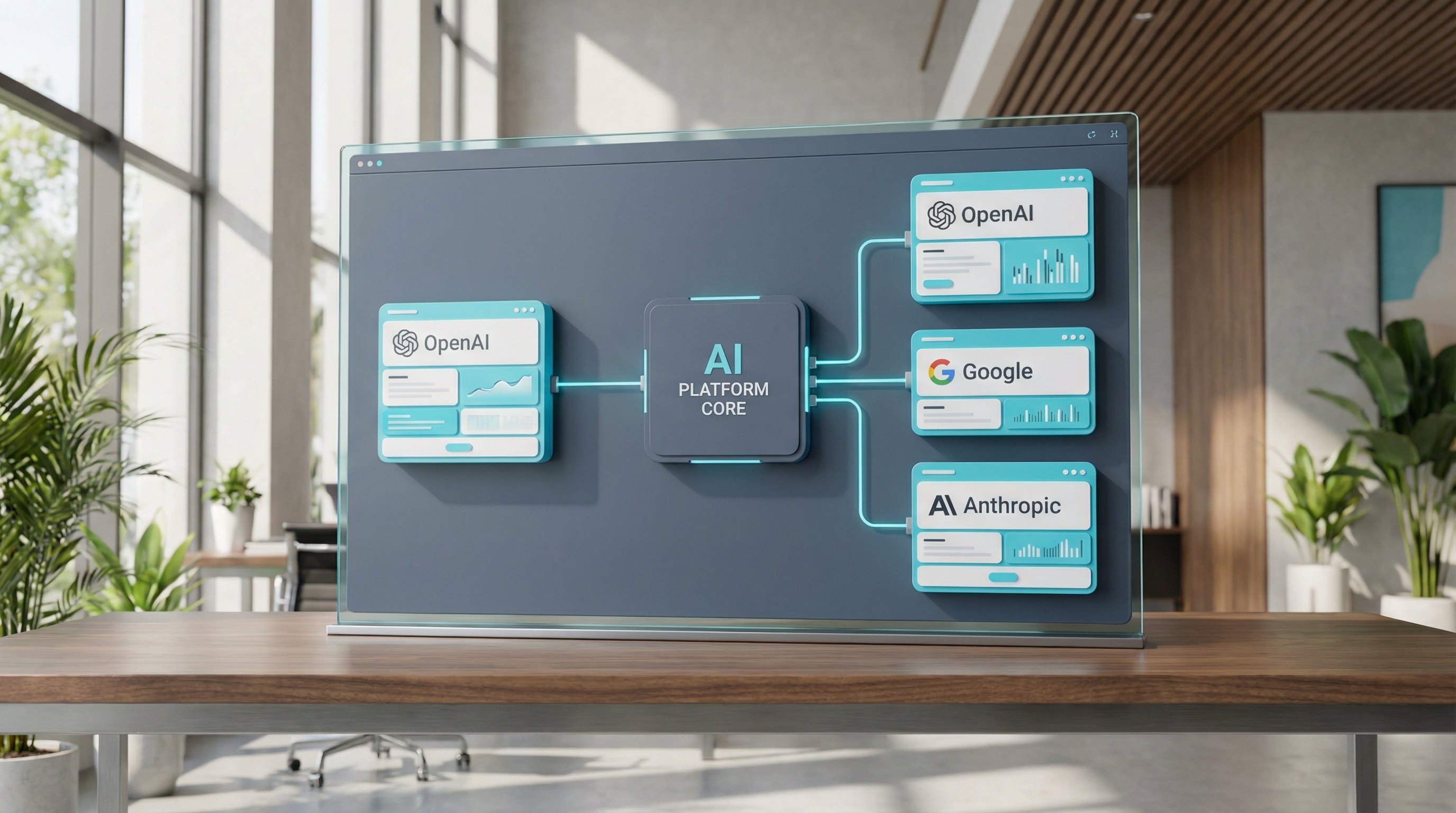
LLM agnosticism—often called "Bring Your Own Model" (BYOM)—is the principle that a platform should be able to integrate with and switch between various underlying LLMs from providers like OpenAI, Google, Anthropic, and open-source alternatives. This flexibility provides immense strategic value. It allows companies to optimize for cost and performance by using the best model for a specific task, avoid disruptive price hikes or policy changes from a single vendor, and prevent dangerous vendor lock-in. An independent model strategy is a hallmark of a mature and future-proof
conversational AI platform.
How to Choose the Right Conversational AI Platform for Your Enterprise
With a clear understanding of the core trends, you can now evaluate potential vendors against a concrete set of capabilities and strategically
choose platformsthat align with your goals. Use this checklist to score and compare platforms, ensuring you select the
right conversational ai platformequipped for the demands of the modern enterprise and its customers.
Finding the Right Conversational AI for Your Needs
Proactive Automation: A Must-Have for Top Conversational AI Platforms
A platform's ability to move beyond reactive responses is paramount. True value is unlocked when the AI can intelligently initiate contact at the most impactful moments in the user journey. When evaluating vendors, demand to see their engine for creating behavior-triggered automations. Can the platform initiate a conversation when a user shows signs of cart abandonment on an e-commerce site? Can it engage a user who is dwelling on a pricing page for an unusual length of time? Can it detect "rage clicks"—a strong signal of user frustration—and proactively offer help? These capabilities are no longer optional. This approach delivers substantial returns. A 2025 analysis by Forrester found that
platforms initiating conversations based on user behavior increased lead conversion rates by an average of 22%. This data underscores the critical need for proactive capabilities to drive real business outcomes. (
Source)
Verifying True Multimodal and Voice AI Capabilities
As discussed, multimodal is now a mainstream requirement. However, many vendors' claims are little more than marketing fluff. It is crucial to verify that a platform can deliver a truly seamless, integrated multimodal experience. During demos, test for the ability to process simultaneous inputs within a single conversational context. The AI should be able to understand a spoken query while analyzing an uploaded image, or parse a video clip while reading accompanying text. This is a non-negotiable feature for modern customer interactions. According to Gartner, this is a top priority for technology leaders. In a 2026 survey of CTOs,
Gartner found that 68% stated that the ability to process and respond with a combination of text, voice, and image analysis was a 'critical' or 'very important' factor in their selection process. (
Source)
Integration Power: The Mark of an Enterprise-Ready Conversational AI Platform
A powerful
conversational AIplatform cannot operate in a vacuum. Its value is magnified by its ability to read from and write to your core business systems. Assess the depth and quality of a vendor's native integrations. Look for robust, pre-built connectors for essential platforms like Salesforce, SAP, HubSpot, and Zendesk. For custom or legacy systems, evaluate the platform's API maturity and the quality of its SDKs. Furthermore, powerful low-code or no-code
ai toolsare essential for empowering business users to build and manage their own custom connections, reducing reliance on overburdened development teams. A strong
AI integrationframework is a sign you've found the
right platformand a mature, enterprise-ready solution.
Using AI Tools for Analytics & Insights: Measuring Your Conversational AI Platform's ROI
The data generated from thousands of customer conversations is a goldmine of business intelligence. A top-tier platform must provide sophisticated tools to extract actionable insights from this data, going far beyond simple metrics like conversation volume or containment rate. Look for advanced analytics suites that include: *
Sentiment Analysis:Track customer satisfaction in real-time across all conversations. *
Topic Clustering:Automatically identify emerging trends and common user issues without manual analysis. *
Journey Mapping:Visualize the paths users take, identifying friction points and opportunities for improvement. *
Insight Generation:The most advanced platforms use AI to analyze conversation data and proactively suggest improvements to conversation flows, knowledge bases, and even business processes.

The 5 Best Conversational AI Platforms for 2026: A Comparative Review
Here we review the leading platforms of 2026, aligning their core strengths with the evaluation criteria we've established. This is not an exhaustive list, but it represents the key archetypes of solutions available today.
1. AetherConverse: The Top Conversational AI Platform for Enterprise
*
Best for:Fortune 500 companies managing complex, multi-departmental customer journeys that span sales, service, and support. *
Key Strengths:AetherConverse's primary differentiator is its market-leading agent orchestration engine, directly addressing the trend toward specialized AI agent fleets. Its platform excels at managing context and state as a customer is handed off between a "Billing Agent," a "Technical Support Agent," and a "Loyalty Agent." It offers robust security, governance, and compliance features, along with support for complex on-premise and Virtual Private Cloud (VPC) deployments. Its strong LLM-agnostic framework is a key feature this
platform offers, giving large enterprises the control they demand. *
Potential Drawbacks:This power comes at a cost. AetherConverse has the highest price point in the market and requires a significant implementation effort, often involving professional services. It is overkill for smaller businesses looking to
deploy conversationalAI for simpler use cases.
2. SynapseAI: A Leading Platform for Proactive Engagement in 2026
*
Best for:E-commerce, SaaS, and marketing-driven organizations focused on conversion rate optimization and
lead generation. *
Key Strengths:SynapseAI is built from the ground up to capitalize on the proactive engagement trend highlighted by Forrester. Its best-in-class, no-code visual workflow builder allows marketing teams to easily create sophisticated, behavior-triggered conversations without writing a single line of code. It features deep, native integrations with marketing automation platforms like HubSpot and Marketo, as well as analytics tools like Google Analytics and Mixpanel, making it a powerful engine for driving revenue. *
Potential Drawbacks:While exceptional for customer-facing sales and marketing, SynapseAI is less focused on complex internal use cases like IT helpdesks or HR automation. Its agent orchestration capabilities are not as mature as those of AetherConverse.
3. Google Dialogflow Vertex: The Premier Voice AI Platform
*
Best for:Organizations heavily invested in the Google Cloud Platform (GCP) ecosystem and those for whom multimodal interaction is a primary business driver. *
Key Strengths:As a native GCP service, Dialogflow Vertex offers unmatched, deeply integrated multimodal capabilities. It seamlessly leverages Google's world-class, proprietary AI models for speech-to-text, translation, and computer vision, making it the clear leader for building experiences that blend voice, vision, and text. The platform's ability to handle these complex interactions natively is a direct answer to the critical need identified in Gartner's research. *
Potential Drawbacks:The platform's greatest strength is also its biggest weakness. It is heavily optimized for the Google ecosystem, which can lead to significant vendor lock-in. Flexibility in using non-Google AI models is limited, making it a less-than-ideal choice for companies pursuing a true LLM-agnostic strategy.
4. CogniFlex: The Most Flexible Conversational AI Platform
*
Best for:Tech-forward companies and enterprises that demand maximum control and flexibility over their AI technology stack. *
Key Strengths:CogniFlex is the purest expression of the "Bring Your Own Model" (BYOM) philosophy. Its architecture is explicitly designed to be model-agnostic, featuring an easy-swap capability that allows developers to switch the underlying LLM with a simple API call. It supports models from OpenAI, Anthropic, Google, Cohere, and various open-source alternatives. This flexibility, as highlighted by IDC's findings on renewal rates, is highly valued by enterprises looking to de-risk their AI investment and optimize performance. *
Potential Drawbacks:This level of flexibility comes with added responsibility. CogniFlex requires more in-house technical expertise to manage, test, and optimize the performance of different models for different tasks. It is not a "plug-and-play" solution.
5. Rasa: The Top Open-Source Conversational AI Platform
*
Best for:Companies with strong in-house engineering and data science teams who require absolute customization, data privacy, and full control over their deployment environment. *
Key Strengths:As an open-source platform, Rasa offers unparalleled control. Your team has full access to the codebase, allowing for deep customization of every aspect of the conversation logic. You control the deployment environment, making it ideal for strict on-premise or specific cloud requirements. Data ownership is absolute, as no conversational data ever needs to leave your infrastructure. Its extensibility is virtually limitless for a skilled development team. *
Potential Drawbacks:The total cost of ownership (TCO) for Rasa can be high when factoring in the required development, maintenance, and infrastructure resources. It is not a solution for teams without dedicated AI/ML engineering talent.

Advanced Strategies for Enterprise Conversational AI Platforms
Beyond individual features, two strategic concepts have the most significant impact on the long-term success of an enterprise conversational AI program. Understanding the shift from designing a single "conversation" to architecting an "orchestration" of specialized agents is critical.
Architecting AI Agent Fleets for Your Enterprise Platform
The most advanced enterprises are no longer building bots; they are building digital workforces. This requires an architectural shift toward an orchestration layer that manages a fleet of specialized
digital workers. Consider a typical customer journey in this model. A user might start by interacting with a "Triage Agent" that identifies their initial intent. If it's a sales query, the user is seamlessly handed off to a "Sales Agent" trained on product specifications and pricing. After the purchase, the same conversational thread is passed to an "Onboarding Agent" to guide the user through setup. The orchestration platform is the intelligent traffic cop, managing context, conversation history, and API calls between these agents to create one unified, efficient experience. This can often be combined with
Robotic Process Automation (RPA)to handle backend tasks triggered by the conversation. This model is proven to be highly effective. A 2025 study from Accenture showed that
companies deploying this model report a 40% reduction in resolution time for complex journeys. (
Source) This is a key part of effective
workflow automation.
Future-Proofing Your Conversational AI Platform in 2026
Relying on a single LLM provider is a risky strategy in 2026. The pace of innovation is too fast, and the
ai marketis too dynamic. An LLM-agnostic or BYOM platform is a critical component of future-proofing your AI investment. The strategic advantages are manifold. You can leverage the best model for a specific task—for instance, using Anthropic's Claude for nuanced creative writing tasks and a Google model for complex data analysis within the same application. You can perform cost-arbitrage, routing traffic to the most cost-effective API provider for a given query type. Most importantly, you de-risk your entire operation from a single provider's sudden price hikes, API deprecations, or shifts in content policy. The business case is compelling: an
IDC MarketScape report showed platforms offering BYOM capabilities had a 55% higher renewal rate among enterprise clients, demonstrating immense long-term value. (
Report)

Best Conversational AI Platforms 2026: FAQ
What is the difference between a chatbot and a 2026 conversational AI platform?
The difference is profound. A traditional chatbot is typically rule-based, reactive, and limited to a single channel like text. In contrast, a
2026 conversational AI platformis proactive, using data to initiate conversations. It's truly multimodal, understanding text, voice, and images simultaneously. Architecturally, these
virtual agentsare often built to orchestrate fleets of specialized
AI agentsto handle complex, end-to-end user journeys, all while being powered by a flexible choice of multiple underlying LLMs.
How much does an enterprise conversational AI platform cost in 2026?
Pricing models for the
top conversational AIsolutions are multifaceted. You can typically expect a combination of: * Seat-based licenses for human agents who use the platform. * Consumption-based fees, often charged per conversation, per monthly active user, or per API call to the underlying LLM. * Annual platform licensing fees that vary based on the feature set. For a mid-to-large enterprise, solutions typically start in the low six figures annually and can easily scale into the millions for large-scale, global deployments.
Can Conversational AI Platforms Handle Voice, Video, and Text in 2026?
Yes, absolutely. This is a defining feature of a modern, leading platform. A user can start a support session by speaking to the AI, then upload a screenshot or a short video of their issue for the AI to analyze, and finally receive a text-based summary of the solution—all within the same, persistent conversational thread. This seamless transition between modalities is a critical capability, as highlighted by recent Gartner research on enterprise priorities.
Conclusion: How to Choose the Right Conversational AI
Selecting the right
conversational AI platform in 2026is a strategic decision that will impact your business for years to come. The choice hinges on a clear understanding of the market's evolution away from simple chatbots and towards proactive, multimodal, and intelligently orchestrated systems. As we've detailed, the "best" platform is not a one-size-fits-all answer. Your ideal solution will be the one
best suitedto your primary business objectives. For large enterprises needing robust governance and the ability to manage complex, cross-departmental journeys, an orchestrator like AetherConverse may be the right fit. For marketing-led organizations focused on driving conversions, a proactive engagement leader like SynapseAI will deliver the most value. And for technically advanced teams that prioritize flexibility and want to avoid vendor lock-in, an LLM-agnostic champion like CogniFlex is the clear choice. Ultimately, conversational AI is no longer just a tool; it's a strategic partner for driving efficiency, creating exceptional customer experiences, and unlocking new avenues for growth. To ensure your investment pays dividends, use the evaluation criteria in this guide to build a comprehensive scorecard for your vendor demos and proof-of-concept projects. If you need help developing your
AI Strategy Consultingframework, please
get startedwith our team of experts.

Author Block