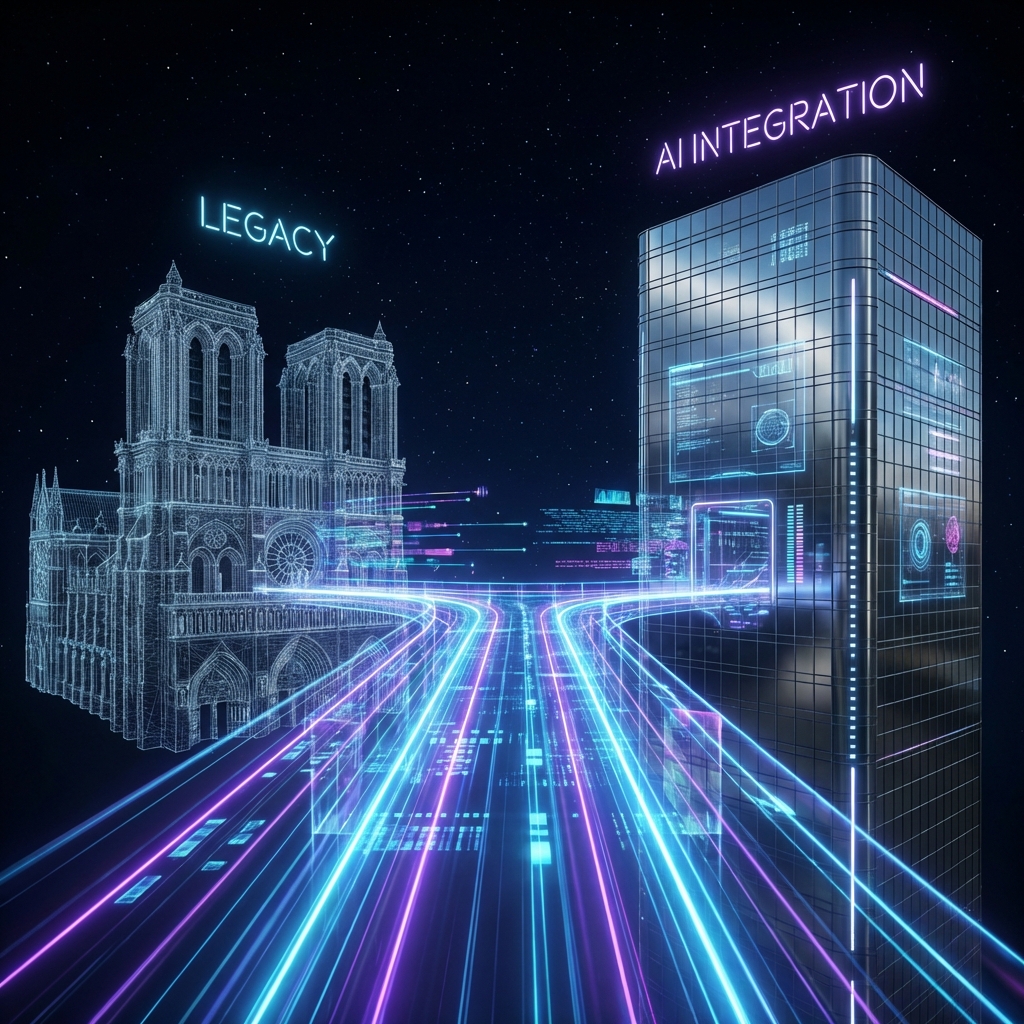
Imagine it's a Tuesday morning in 2026. Your home's AI assistant, noting your health wearable's data and your upcoming marathon training schedule, proactively adds electrolytes and high-protein snacks to your weekly grocery order. Simultaneously, it pushes a notification to your AR glasses suggesting a new running route that avoids today’s predicted air quality issues, all based on preferences you shared months ago. This isn't science fiction; this is the baseline customer expectations for customer engagement.

In 2026, personalized customer interactions are no longer a competitive advantage; they are the fundamental price of entry for any brand that wants to remain relevant. The gap between businesses that master this art and those that cling to generic, one-size-fits-all messaging has become a chasm. This demands a refined approach to personalized customer engagement . This guide will explore the essential strategies, technologies, and data principles defining this new era, from leveraging generative AI and zero-party data to avoiding the catastrophic costs of impersonal service.
The Paradigm Shift: Why Every Customer Interaction Must Be Personalized in 2026
We've moved far beyond the rudimentary demographic-based segmentation of the 2010s. The once-celebrated strategy of targeting "males, 18-34, living in urban areas" now seems laughably archaic. The current standard is predictive, one-to-one hyper-personalization, a paradigm shift driven by evolving technology and radically new customer needs. Brands must evolve rapidly to meet customer expectations . But personalization isn’t just about technology; it’s about a fundamental shift in business philosophy.
To truly excel in this era, businesses must learn to tailor every aspect of their interaction strategy. It's not enough to segment customers broadly; the goal is to precisely tailor customer experiences , communications, and support to the unique profile of each individual. This means understanding their journey, anticipating their needs, and having the agility to tailor solutions in real-time. Brands that can effectively tailor their approach will cultivate deeper customer loyalty , proving they genuinely understand and value their clientele. The ability to tailor is paramount.
The rise of ambient computing, where technology is seamlessly woven into our environment, has conditioned us to expect more. Our IoT devices—from smart homes that learn our routines to wearables that track our vitals—have created a world where anticipation is the norm. Customers now bring this expectation to every interaction , assuming you know who they are, what they need, and what they will need next, all in real-time.
The key differentiators that define market leaders in 2026 are:
- Proactive vs. Reactive: The old model was reactive, recommending products based on past purchases. The new model is proactive, aiming to solve problems before the customer is even aware of them. A brand doesn't just sell you a new water filter; it alerts you that your current filter is losing efficacy based on usage data and has a replacement ready for one-click ordering.
- Emotional Resonance: Advanced AI now analyzes sentiment and tone in customer communications. This allows brands to deliver empathetic, context-aware responses that feel genuinely human. If a customer expresses frustration in a chat, the AI can instantly craft a personalized message or adjust its language and escalate the issue to a human specialist with full context.
- Contextual Continuity: The modern customer journey is fluid, moving from a smart speaker to a mobile app to an an in-store kiosk. To truly personalize interactions and experiences demands that this is a single, unbroken conversation. The context of the interaction must follow the user across every touchpoint, eliminating the friction of having to start over.
Optimizing the Experience for Customers : The Data Foundation for Personalization
With the complete deprecation of third-party cookies now a settled reality, the imperative for brands to own their customer data relationships is absolute. To effectively leverage customer data , the era of passively tracking users across the web is over. The future is built on data that is given, not just taken. This requires a clear understanding of the new data hierarchy.
Ultimately, the strategic collection and utilization of data serve one overarching goal: to create personalized experiences . When brands master this, they move beyond simple transactions to create memorable journeys that resonate deeply with customers. The ability to personalize experiences fosters trust and strengthens brand affinity, transforming fleeting interactions into lasting relationships. In 2026, the imperative to personalize experiences is not just a marketing tactic, but a core business strategy for sustained growth.
The most valuable data tiers for personalization are:
- Zero-Party Data: This is the new gold standard. It is data a customer intentionally and proactively shares with a brand. This includes customer preferences , purchase intentions, personal goals (like training for a marathon), and values. It is the most powerful data to improve the customer experience because it comes directly from the source.
- First-Party Data: This is the data you collect from a user's direct interactions with your properties, such as their browsing history, customer behavior , purchase history, and app usage. While still vital, it is observational and requires inference; zero-party data is explicit.
Building Trust to Personalize the Customer Experience
Building a zero-party data strategy is built on a foundation of trust, allowing brands to gain crucial insights into customer motivations, thus driving effective customer personalization . A landmark 2025 study by Forrester Research found that 82% of consumers are willing to share their data directly with a brand in exchange for tangible value and transparency. ( Study )
This "value exchange" is the core of the modern brand-customer relationship. In 2026, tangible value means:
- Hyper-relevant recommendations that save a customer time and mental energy.
- Exclusive access to products or services configured specifically for them.
- Personalized financial advice or health insights based on their stated goals.
- Custom-configured digital and physical experiences, often enabled by robotic process automation .
Transparency isn't just a link to a privacy policy buried in your website's footer. Transparency in action means showing customers exactly how their data is used to improve customer experience. It’s a simple message that says, "Because you told us you're training for a marathon, we're recommending these high-endurance running shoes." This closes the loop and reinforces the value of the data they've shared.
Actionable strategies for collecting zero-party data include:
- Interactive quizzes and style finders.
- Gamified onboarding processes that ask for preferences.
- AI-driven conversational AI surveys that feel like a natural dialogue.
The Unmistakable Benefits of Personalized Service and Shopping Experience Examples
The term "omnichannel" has been around for years, but only now has the technology caught up to its true promise. It's critical to understand the difference between a multichannel presence—simply existing on many channels—and a true omnichannel strategy, which creates a single, unified customer experience and provides personalized service across them all.
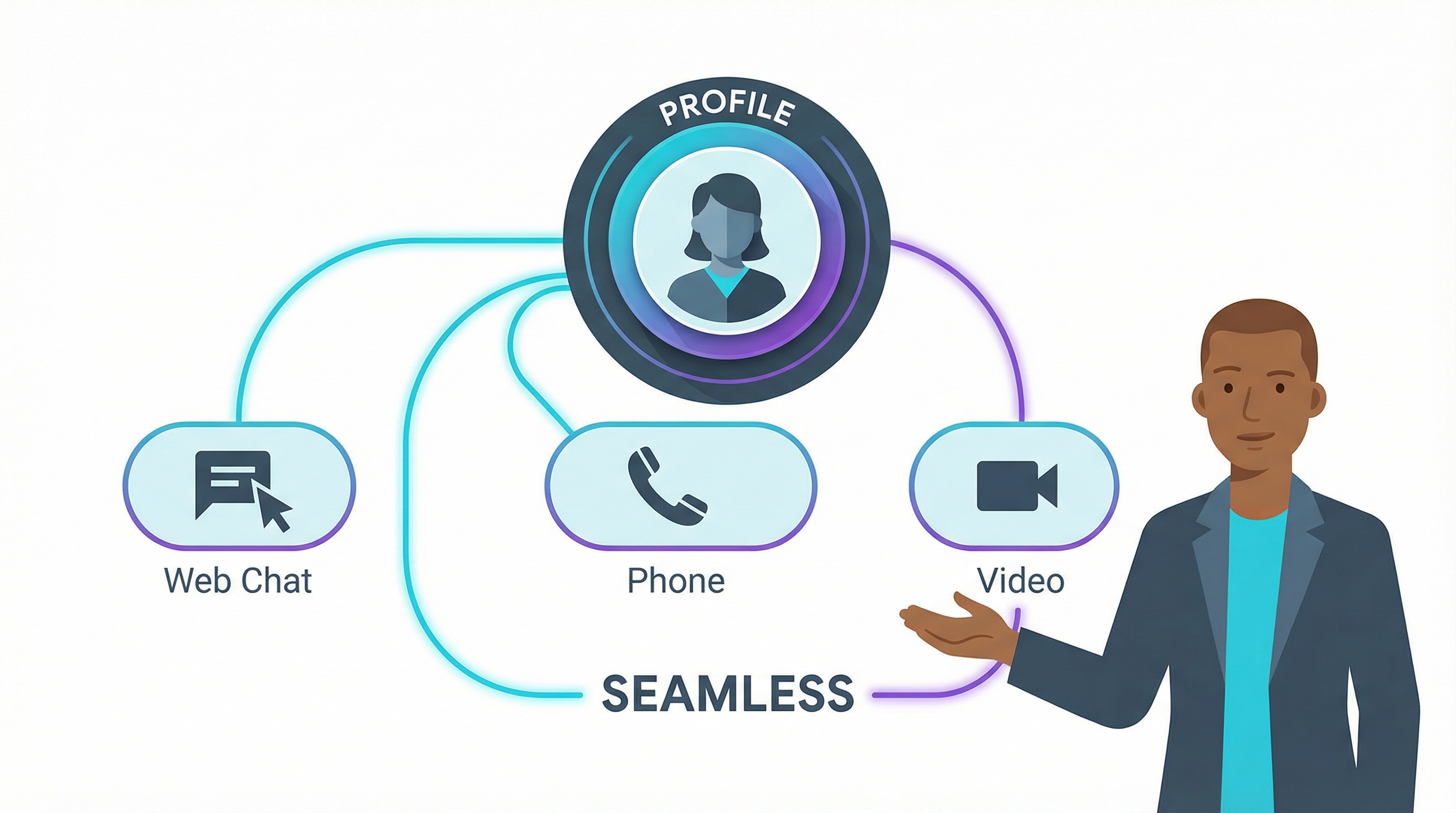
In 2026, a brand that forces a customer to restart a conversation when they switch from a web chat to a phone call is considered broken. The omnichannel standard is now defined by two core components:
- The Unified Customer Profile: This is a single, real-time view of the customer that is accessible by every system, from marketing automation and sales CRMs to service desks and in-store technology. It is the central nervous system of a modern customer experience, powered by a robust Customer Data Platform (CDP).
- Seamless Handoffs: A truly integrated system enables effortless transitions. A customer might start a query with a chatbot, which then seamlessly transfers the entire conversation—with full context—to a human agent for a video call. That agent can then push a proposed solution directly to the customer's AR glasses for visualization. Achieving this level of fluidity requires a sophisticated AI integration strategy.
The Benefits of Personalized Customer Service: Driving Loyalty Everywhere
The benefits of personalized and true omnichannel strategy are staggering. According to a 2026 report from Gartner, brands with fully integrated personalization strategies achieve 78% higher customer retention year-over-year compared to those with siloed approaches. ( Source )
The reason behind this massive difference is simple: siloed channels are the primary source of customer frustration . When a customer has to repeat their issue, re-enter their account number, or receives conflicting information on different channels, trust erodes instantly. A unified profile, on the other hand, demonstrates that the brand knows and values each specific customer , fostering the deep loyalty that drives long-term growth. The ability to provide a consistent, better customer experience across all touchpoints is crucial.
Consider this modern customer journey:
- A customer browses a jacket on their laptop.
- Later, they see a targeted ad for the same jacket on a social media app and add it to their cart.
- The next day, as they walk past a physical store, they get a notification on their smartwatch: "The jacket in your cart is in stock. Come try it on with our AR mirror."
This is the power of a unified, personalized customer journey.
Using Personalized Generative AI for Real-Time Customer Interactions
In the early 2020s, generative AI was primarily seen as a tool for creating content or powering chatbots. Today, in 2026, its role has evolved dramatically. Generative AI is now the core engine for real-time, dynamic journey orchestration , personalizing interactions at a scale and speed previously unimaginable.
Its core capabilities have moved far beyond basic automation:
- Dynamic Content Generation: Forget static landing pages. Generative AI can instantly create and serve personalized website copy, product descriptions, and email content based on a user's real-time customer preferences and behaviors and zero-party data profile. The page a user sees is built for them, in that exact moment.
- Predictive Pathing: By analyzing millions of data points across the customer base, generative AI can predict an individual's next likely move. It then dynamically alters the user interface, communication flow, or next-best-action to guide them toward their optimal outcome, smoothly and intuitively. These decisions are often carried out by autonomous AI agents designed to optimize the customer experience and enhance service interactions .
Deliver Personalized Customer Conversations to Boost CLV by 25%
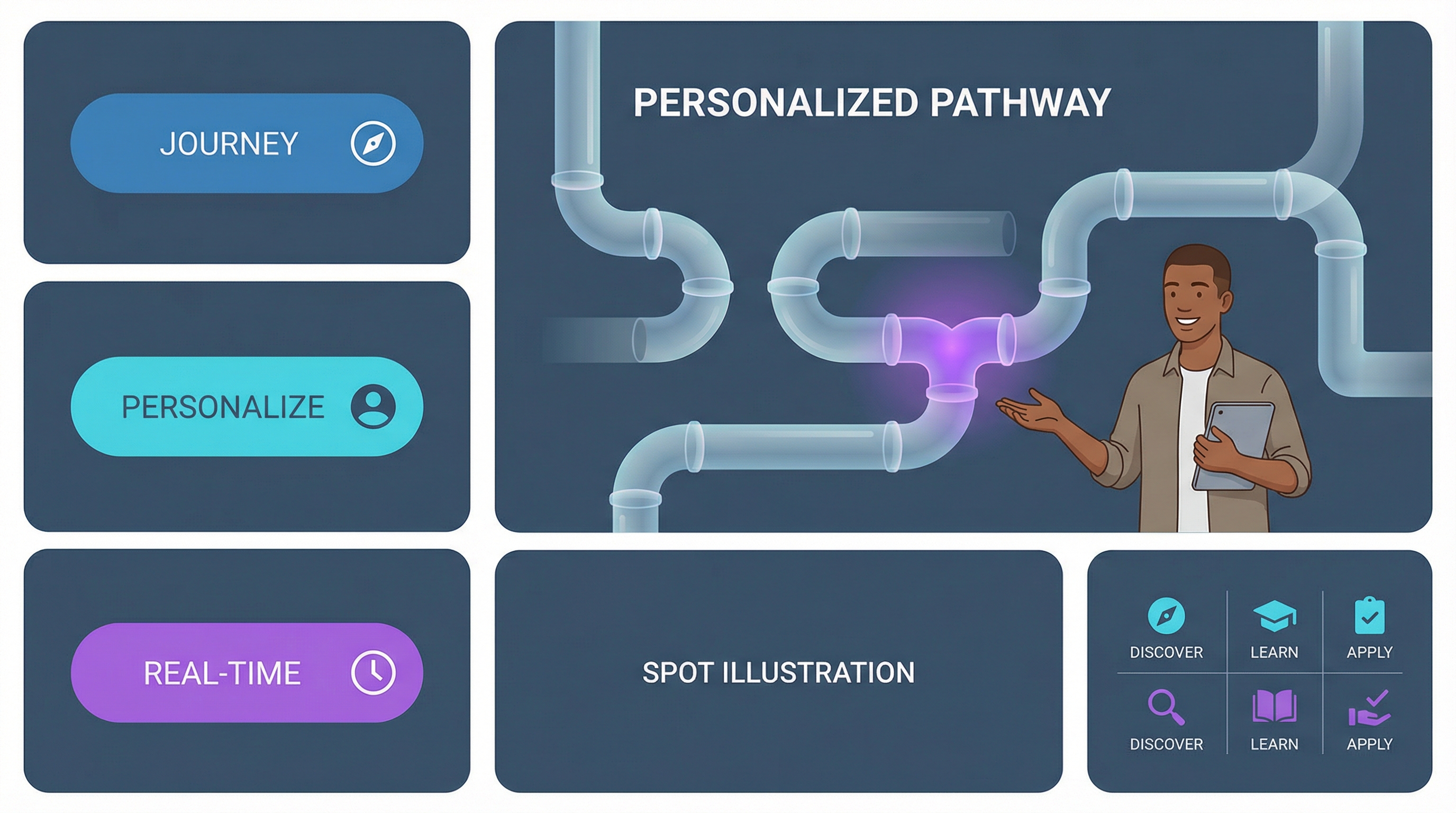
The financial impact of this shift is profound. A groundbreaking 2026 report from McKinsey & Company revealed that companies using generative AI for journey orchestration see a 25% increase in Customer Lifetime Value (CLV) . ( Reference )
This incredible lift comes from generative AI's ability to create fluid, adaptable journeys. Traditional personalization models relied on rigid "if-then" logic. In contrast, generative AI operates on probabilities and context. If a customer shows hesitation on a checkout page, the AI can instantly and autonomously trigger the most effective intervention—whether it’s to offer personalized discount, a helpful tutorial video, or an invitation to chat with a product specialist to respond to customer needs proactively.
This constant, real-time optimization maximizes conversion at every step of the journey. More importantly, it builds a deeply satisfying and frictionless experience that encourages repeat business, transforming one-time buyers into lifelong advocates and dramatically increasing the overall value of the customer relationship.
The High Cost of Failing to Personalize the Customer Experience
In the hyper-personalized landscape of 2026, customer tolerance for generic, one-size-fits-all interactions has fallen to zero. An impersonal experience, especially the failure to personalize customer service , is no longer a missed opportunity; it is an active liability that directly damages your bottom line and your brand reputation. This lack of a truly personalized approach is a critical weakness.
Failing to personalize an interaction is a clear signal to the customer that you don't know them, you don't value their history, and you don't respect their time. In an economy built on relationships, this is a fatal error.
The Impact of Impersonal Service: Failing at Customer Support
The data on this is unequivocal. The 10th edition of Salesforce's "State of the Connected Customer" report found that 68% of customers have ended a business relationship due to a brand's failure to recognize their history and context across touchpoints. ( 2025 Report )
In 2026, this failure manifests in several infuriating ways:
- Treating a loyal, 10-year customer with a welcome email sequence designed for a new prospect.
- Asking a customer for an account number on a service call that they just spent 30 seconds entering into the automated phone system.
- Sending a promotional offer for a product the customer purchased last week—or worse, just returned.
Each of these moments of disconnect shatters the illusion of a relationship and exposes an inefficient, siloed operation.
The damage from these failures is quantifiable and severe:
- Increased Churn Rate: The most direct cost is the loss of revenue from departing customers, often exacerbated by negative customer feedback and reviews.
- Skyrocketing Acquisition Costs: It remains exponentially more expensive to acquire a new customer than to retain an existing one. Failing at personalization forces you onto this costly treadmill.
- Brand Erosion: Negative sentiment and stories of poor experiences spread instantly through social networks, damaging your brand's reputation and poisoning future acquisition efforts.
Achieving Personalization at Scale with Generative AI and Data
How to Deliver Personalized Customer Experiences: A Step-by-Step Guide
Understanding the "why" of personalization is essential, but execution is what separates leaders from laggards. Here is a clear, actionable framework for building or refining your company's personalization engine.
Step 1: Unify Data to Personalize Every Customer Interaction
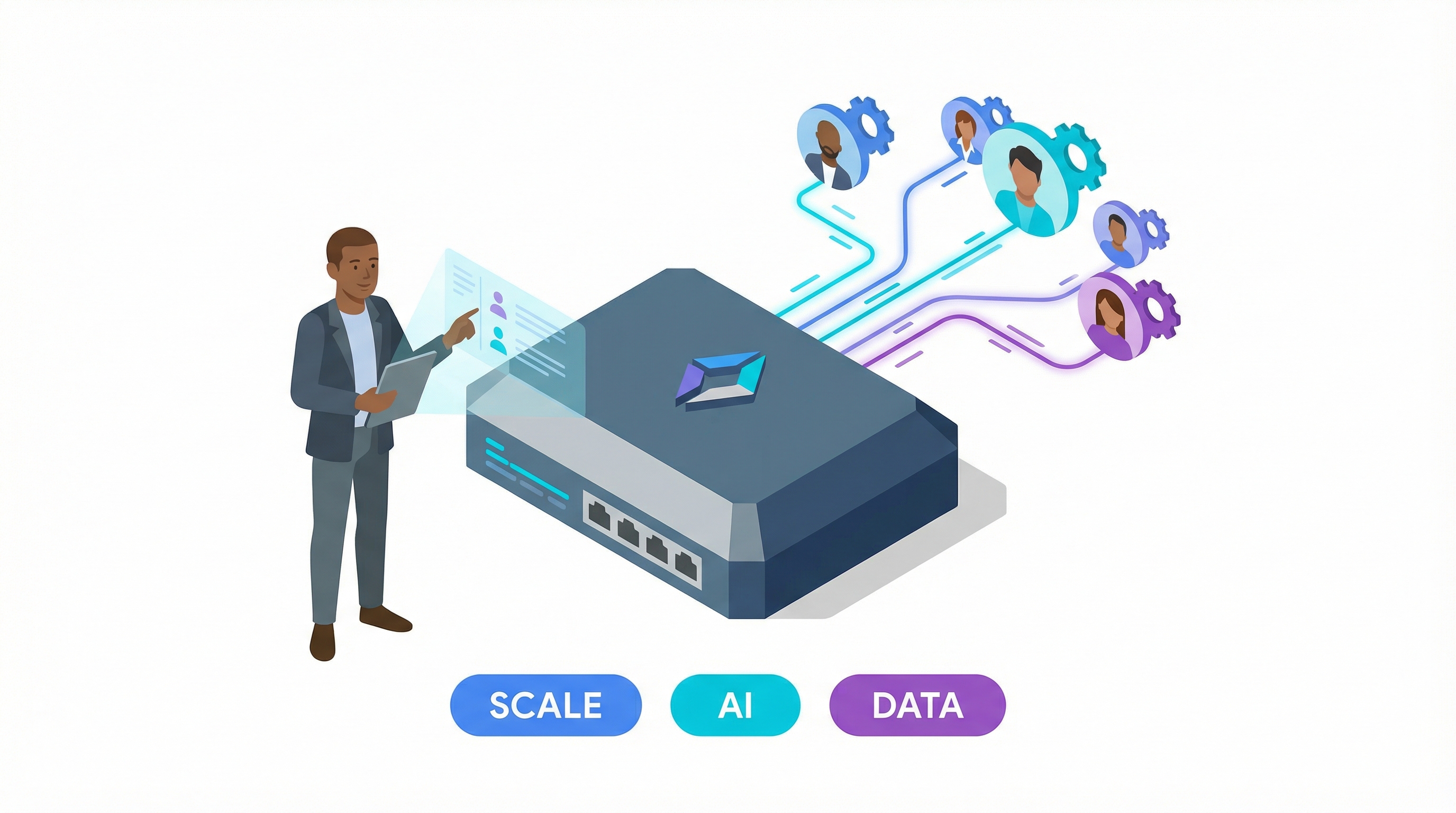
You cannot personalize what you cannot see. The first step is to break down internal data silos. The central technology for this in 2026 is the Customer Data Platform (CDP) . A CDP ingests data from all sources—your CRM, e-commerce platform, IoT feeds, and zero-party data collection tools—to create that critical unified customer profile. A successful implementation requires deep expertise in system architecture and AI integration .
Step 2: Map Journeys to Deliver Personalized, High-Impact Moments
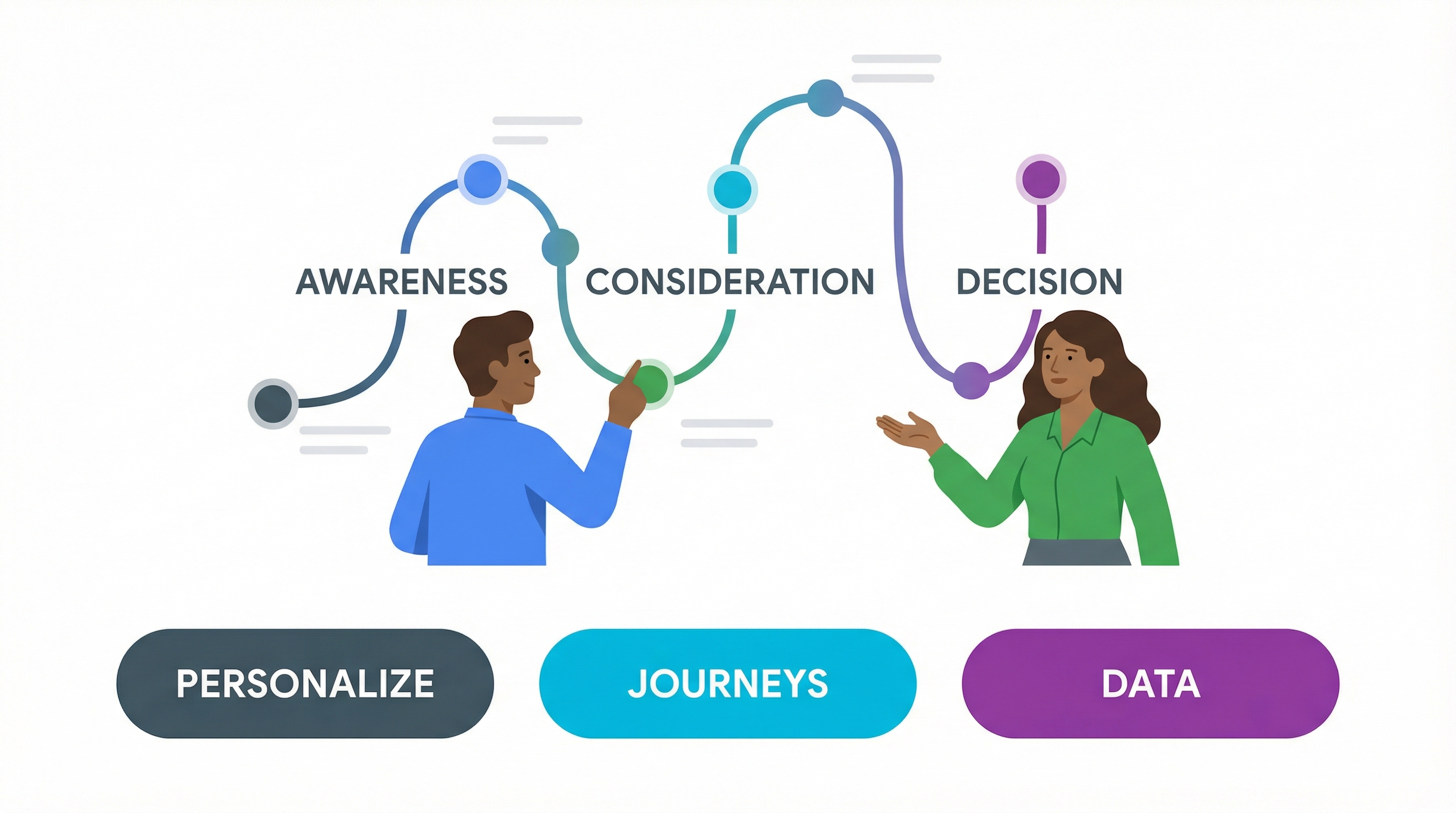
Don't try to personalize everything at once. Begin by mapping your most critical customer journeys, such as new customer onboarding, the first purchase experience, or a post-sale service request. Within these journeys, identify the "moments of truth" where a personalized customer interaction can have the most significant positive impact on the experience.
Step 3: Test and Scale Your Personalized Customer Experience Strategy
Adopt a "crawl-walk-run" approach to implementation. This allows you to secure early wins, learn from data, and build momentum for broader initiatives.
- Crawl: Start with simple, high-impact tactics like personalizing email subject lines with a customer's name and referencing a past purchase.
- Walk: Progress to implementing dynamic content blocks on your website's homepage that change based on a visitor's known interests or past browsing behavior.
- Run: Evolve to full, real-time journey orchestration, using generative AI to deliver dynamic offers and completely personalized communication flows across all channels.
Step 4: Measure the Impact of Personalized Customer Service
The success of a personalization strategy cannot be measured by vanity metrics like clicks and open rates. You must focus on KPIs that reflect real business impact. Track metrics like Customer Lifetime Value (CLV) , Net Promoter Score (NPS) , Customer Satisfaction (CSAT) , and, most importantly, year-over-year customer retention rate . These are the numbers that prove your investment is fostering genuine loyalty.
Your Personalized Customer Interaction FAQ
How Can Small Businesses Deliver a Personalized Customer Experience?
The democratization of AI has been a game-changer. Many leading SaaS platforms now offer sophisticated personalization engines and CDPs at scalable, subscription-based price points. The key for small businesses is to start by mastering the collection of zero-party and first-party data—which is low-cost and high-impact—before investing heavily in enterprise-level technology. Focus on the data you own first and optimize your digital marketing efforts .
What’s the Difference? Personalization vs. Hyper-Personalized Customer Interactions
Personalization often operates on broader data segments (e.g., "shoppers who bought X also bought Y"). Hyper-personalization is a real-time, one-to-one interaction. It uses a comprehensive, dynamic understanding of an individual's immediate context, past behavior, and stated preferences to create a unique experience tailored to that exact moment.
How Do You Personalize Customer Service While Respecting Privacy?
The balance is achieved through the zero-party data framework. The key is radical transparency . Be crystal clear with customers about what data you're collecting, why you're collecting it, and exactly how it will be used to benefit them. Make privacy controls simple and accessible. The goal is to make the customer an active partner in the personalization process, not a passive subject of data collection.
What Is the Next Trend for Every Customer Interaction Beyond 2026?
The next frontier is "ecosystem personalization." This involves brands forming secure, consent-based data alliances to personalize customer service further and offer seamless experiences across different companies. For instance, your airline, hotel, and rental car service could share relevant journey data (with your explicit permission) to proactively manage travel disruptions, pre-populate preferences, and create one holistic, personalized trip experience.
Conclusion: Personalize Every Customer Interaction or Perish
In 2026, the mandate is clear: personalize or perish . The brands that are winning are those that have moved beyond transactional campaigns to build deeply empathetic, context-aware relationships with their customers. This new standard is non-negotiable, driven by a transparent exchange of zero-party data, and supercharged by the orchestration capabilities of generative AI.
Ultimately, the leaders of this era are not the companies with the most data, but those who have earned the deepest trust. It's time to stop thinking in terms of channels and campaigns and start building unified, valuable, and truly personal customer relationships. If you're ready to build your personalization engine and refine your AI strategy consulting , get started with our experts today.
Author Block